
If you spend time fishing lakes or rivers across Northern Ireland, you'll hear Frankie McPhillips mentioned often - on fly box labels, in tackle shop conversations, or at the waterside. Yet who he actually is, what makes his flies distinctive, and whether they deserve a place in your box often gets left unexplained.
I've fished for over 40 years across Ireland, Scotland, Scandinavia and Canada, handling plenty of hand-tied flies along the way. As someone running Mid Antrim Angling and stocking Frankie McPhillips flies alongside other Irish-tied patterns, I want to give you a practical assessment rather than a sales pitch dressed up as a review.
Who Is Frankie McPhillips?
Frankie McPhillips hand-ties trout, salmon and sea trout flies from Tempo, County Fermanagh, using traditional Irish patterns and techniques. He runs a specialist, appointment-only business and has built a solid reputation within Irish fly fishing circles over several decades.
Based in Tempo, County Fermanagh
McPhillips operates from 77 Main Street, Tempo, County Fermanagh - detail confirmed on his official website. Fermanagh itself is prime fly fishing country, home to the Upper and Lower Lough Erne systems and a string of smaller waters that shaped generations of Irish fly patterns. His Facebook business page notes the shop runs on an appointment-only basis rather than fixed hours, a common model for specialist tyers who work largely to order and through stockists.
Several Decades of Professional Tying
Here's where I need to be straightforward. His own website references over 30 years of fly tying experience, while other sources put the figure closer to 45 or even 47 years. I can't verify which is current or most accurate. Rather than pick one and present it as fact, it's fairer to say McPhillips has worked professionally for several decades - somewhere in the 30 to 47 year range depending on how you mark his start date. What matters more than the exact number is how consistently his reputation has held across a long career, which shows in how often his name comes up among Irish anglers and tackle shops.
Key details at a glance:
| Detail | Information |
|---|---|
| Location | Tempo, County Fermanagh, Northern Ireland |
| Nearby hub | Enniskillen |
| Experience | Several decades tying professionally (sources vary: 30+ to 47 years) |
| Specialism | Trout, salmon and sea trout flies, plus tying materials |
| Shop model | Appointment-only, with flies also sold through stockists |
What Sets Frankie McPhillips Flies Apart
Traditional Irish Tying
Irish fly tying has developed its own character over centuries of fishing on loughs like Erne, Melvin and Conn, and rivers like the Moy and Drowes. The patterns favour buoyant, visible silhouettes for broken water and breezy lough drifting, alongside the slim, sparse dressings used in low summer water on rivers. McPhillips ties within this tradition rather than chasing trends, which is why Irish anglers recognise his work as rooted in something proven rather than fashionable.
Materials and Construction
I haven't personally tested every pattern he produces, so what follows is a quality framework rather than a first-hand verdict on each fly. When judging any hand-tied pattern - whether from McPhillips or anyone else - what matters is hook quality (sharpness, temper and gauge), the durability of the whip finish and head cement, how well the materials sit proportionally, and how the fly behaves in water.
Traditional Irish tyers typically work with quality hooks from manufacturers like Mustad, natural materials such as cock and hen capes, and increasingly CDC (cul de canard) feather for buoyant dry patterns. A well-tied fly sits correctly in the water, shows no loose wraps, and holds up to several fish before replacement.
Known Patterns Including the River Moy Shrimp
One detail that comes up frequently with McPhillips is a shrimp pattern linked to the River Moy in County Mayo, one of Ireland's best salmon and sea trout rivers. Shrimp and prawn imitations have long worked well for both spring salmon and summer grilse on the Moy. Beyond this, his catalogue spans salmon tubes, trout wets and dries, placing him as an all-round Irish tyer rather than a specialist in one narrow style.
The Range: What McPhillips Ties
Salmon and Sea Trout Flies
Salmon and sea trout flies come in several mounting styles. Understanding the difference helps you buy what you actually need:
- Tube flies are tied on a plastic, brass or aluminium tube with the hook added separately when fishing. This means you can adapt to different water heights and swap a damaged hook without losing the dressing.
- Bottleneck tubes sit narrower, letting the hook sit closer to the dressing - often preferred for smaller summer patterns.
- Conehead tubes carry a weighted metal cone at the head to help the fly sink faster in cold, high water during spring.
- Doubles tie onto a hook with two points, giving better hook-ups in faster water.
- Trebles carry three points and feature on smaller or weighted patterns where a stronger hold matters.
Trout Flies
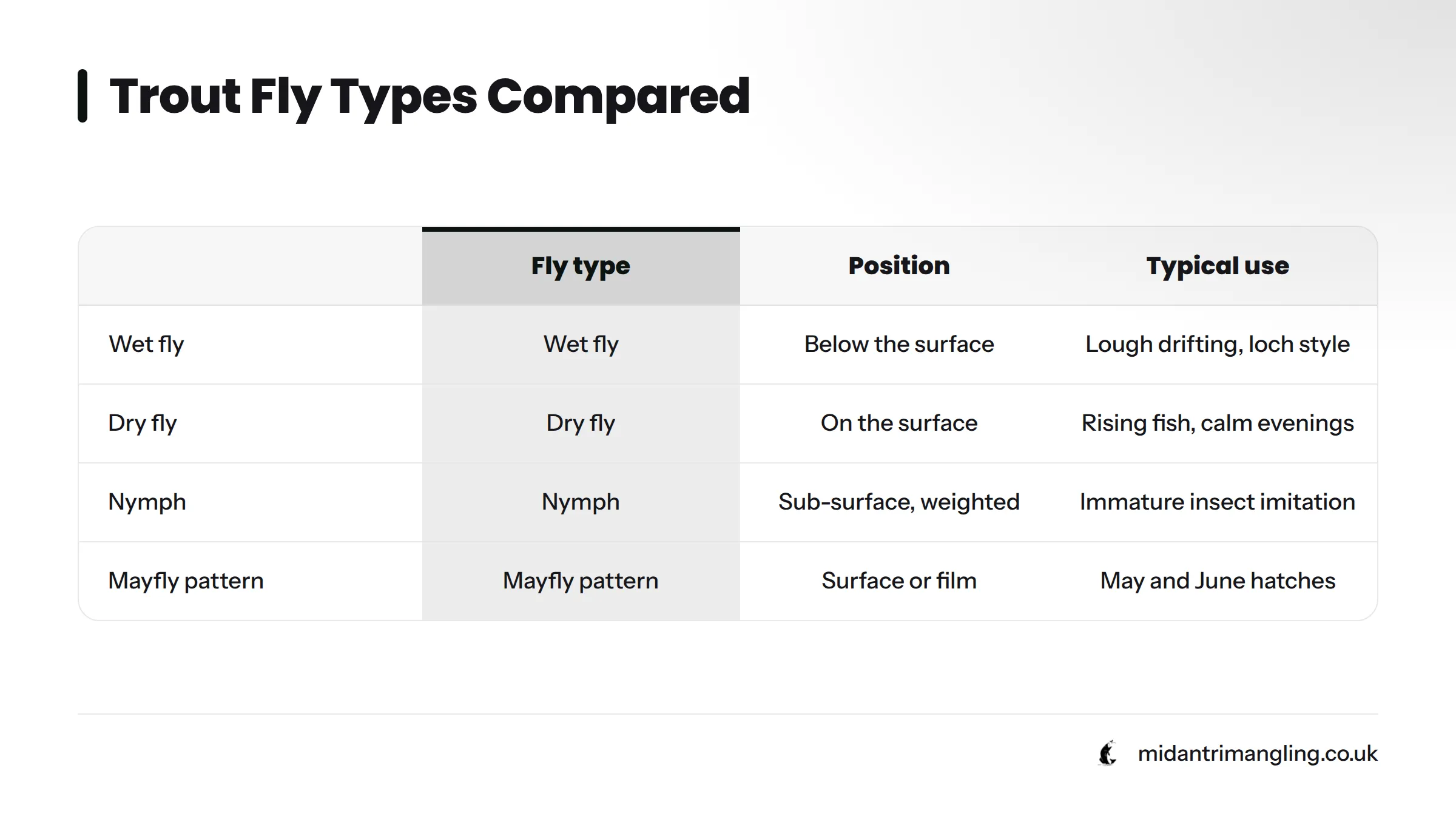
For trout fishing, the first useful distinction is wet versus dry. A wet fly ties to sink and fish below the surface, imitating emerging insects, drowned flies or small baitfish - a mainstay of traditional Irish lough-style fishing. A dry fly ties to float on the surface film, imitating adult insects such as mayfly, sedge or midge, fished when fish are rising and feeding on top.
| Fly type | Where it sits | Typical use |
|---|---|---|
| Wet fly | Below the surface | Lough drifting, loch style, searching water |
| Dry fly | On the surface | Rising fish, calm evenings, mayfly hatches |
| Nymph | Sub-surface, often weighted | Imitating immature insects, river and lough |
| Mayfly pattern | Surface or film | May and June hatches on Irish loughs |
Materials and Kits
Alongside finished flies, McPhillips offers fly tying materials and kits, showing the business serves tyers as well as anglers wanting ready-made patterns. This dual offering - tied flies plus raw materials - is typical of established Irish tyers who supply both the angling public and the home tying community.
| Category | Typical contents | Best suited to |
|---|---|---|
| Salmon and sea trout flies | Tubes, doubles, trebles | River Moy, Drowes, Erne system salmon and sea trout |
| Trout flies | Wets, dries, nymphs, mayflies | Lough and river trout across Fermanagh and beyond |
| Tying materials | Hooks, capes, dubbing, tinsel | Anglers who tie their own flies |
| Kits | Selections and starter sets | Beginners building a first fly box |
Our Verdict on Quality
Hook Quality and Durability
Without having tested a specific batch myself, I can speak to what separates a durable fly from a disappointing one. Look for a hook with a consistent, sharp point straight from the packet, a whip-finished head properly cemented so it doesn't unravel after a fish or two, and materials tied tight enough not to spin loose around the shank. Established Irish tyers working to a long-standing reputation generally maintain these basics - a tyer's name is only as good as the last box of flies that left the bench.
Pattern Accuracy and Fishing Performance
Pattern accuracy matters more than people sometimes realise. A fly that looks good in a box but doesn't sit, sink or swim correctly in the water won't catch fish, no matter how neatly finished. Traditional Irish patterns are proven over generations of use on specific waters, which is part of the value of buying from a tyer rooted in that tradition rather than a mass-produced import. I'd treat McPhillips' long-standing reputation within the Fermanagh and wider Irish fly fishing community as a reasonable indicator that his patterns are tied with fishing performance in mind, not just appearance.
Who Benefits Most
Beginners will find the kits and standard trout patterns a sensible way to build a first fly box without guesswork, since they're based on proven Irish patterns rather than trial and error. More experienced anglers targeting rivers like the Moy or fishing lough style for brown trout will appreciate the specialist salmon and sea trout range and the option to buy raw materials for their own tying.
Honest verdict: based on his decades in the trade, the breadth of his range, and his standing within Irish fly tying circles, McPhillips flies are a sound, traditional choice for anglers wanting proven Irish patterns rather than generic imports. Start with a small selection suited to your target species and water before committing to a large order - good practice with any tyer, however established.
For a sense of how fly quality gets judged against cheaper alternatives, this video comparing budget online flies shows what separates careful hand-tying from mass production: https://www.youtube.com/watch?v=5MWGDE03w1k
How McPhillips Compares to Other Irish-Tied Flies
Mid Antrim Angling stocks several Irish fly ranges. Here's how they sit alongside each other:
| Tyer | Style | Specialism | Best suited to |
|---|---|---|---|
| Frankie McPhillips | Traditional Irish, broad range | Trout, salmon and sea trout flies plus tying materials | All-round anglers wanting proven patterns across species, and tyers wanting quality raw materials |
| Bann Valley | Traditional Irish wet and dry patterns | Lough and river trout | Anglers focused on Irish trout fishing traditions |
| Caledonia Fly Company | Scottish-influenced tying | Salmon and sea trout | Anglers fishing larger salmon rivers and Scottish-style waters |
McPhillips comes out as the strongest all-round option if you want one source covering trout, salmon and sea trout plus materials for your own tying bench. Bann Valley is worth looking at if you're purely focused on lough and river trout work. Caledonia Fly Company suits anglers leaning towards a more Scottish-style salmon approach. None are poor choices, but for range and depth of tradition, McPhillips edges ahead for most anglers shopping with us.
How to Choose the Right Frankie McPhillips Fly
Start with Your Target Species
Begin with what you're actually fishing for. Trout fishing on Irish loughs calls for a different box to salmon fishing on a river like the Moy. Sea trout at dusk demands a different silhouette again compared with daytime brown trout work.
Match Patterns to Your Water
Lake and river fishing demand different approaches. Lough-style wet flies are designed for drifting - often in a team of three down the leader - while river trout flies need to cope with current and presentation at closer range. Pairing the right fly with the right line matters as much as the fly itself. If you're not confident on line choice, our complete fly lines guide is worth reading before you build a new box.
5 things to check when buying tied flies:
- Inspect the hook point for sharpness and consistent temper.
- Check the whip finish and head cement for signs of unravelling.
- Look for even proportions between tail, body and hackle.
- Confirm the pattern suits your actual target species and water type.
- Buy a small trial selection before committing to a full box of one pattern.
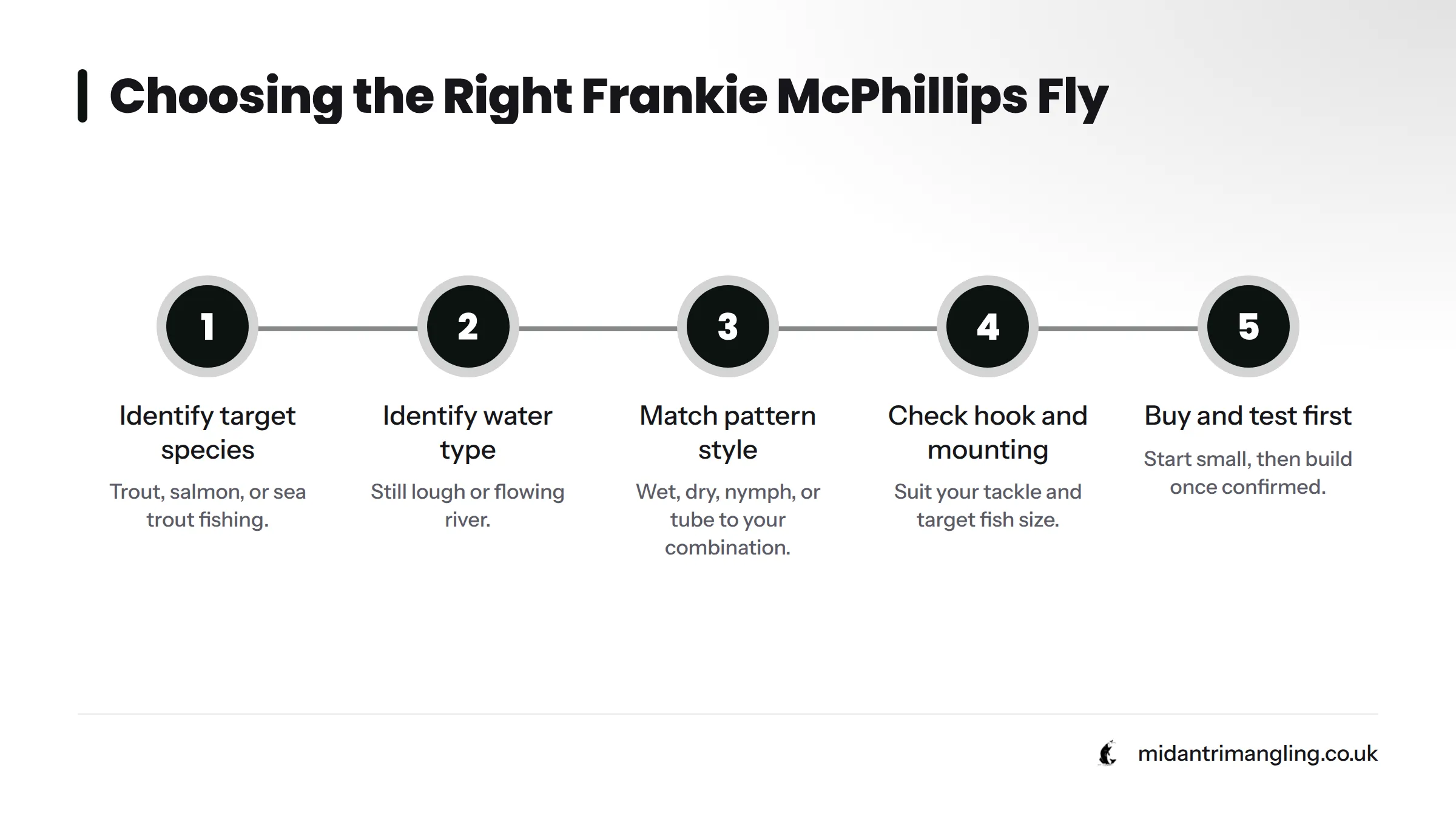
Choosing the right fly - step by step:
- Identify your target species (trout, salmon, sea trout).
- Identify your water type (still lough, flowing river).
- Match the pattern style (wet, dry, nymph, tube) to that combination.
- Check hook and mounting style suits your tackle and target fish size.
- Buy a small selection first, then build out once you've confirmed what works.
Where to Buy Frankie McPhillips Flies
Buying from Mid Antrim Angling
We stock a range of Frankie McPhillips flies here alongside other established Irish and UK tying houses. Buying through a specialist stockist rather than visiting an appointment-only shop offers practical advantages: you can browse complementary tackle, get advice on pattern choice for your specific water, and avoid arranging a visit to Tempo.
Stock Levels and What to Expect
As with any specialist fly range, stock levels on individual patterns vary depending on demand and tying capacity - these are hand-tied rather than mass-produced on a production line. If you're after a specific pattern, it's worth checking availability before planning a trip around a particular fly. You can also check customer sentiment on McPhillips through his listing on Trustpilot, which gives a sense of wider customer experience beyond what I can verify first-hand.
Frequently Asked Questions
Who is Frankie McPhillips? Frankie McPhillips is an Irish fly tyer based in Tempo, County Fermanagh, who hand-ties trout, salmon and sea trout flies and runs an appointment-only fly tying business with decades of professional experience.
Where is Frankie McPhillips based? He's based at 77 Main Street, Tempo, County Fermanagh, Northern Ireland, with his business also associated with nearby Enniskillen.
How long has Frankie McPhillips been tying flies? Sources vary, ranging from over 30 years on his own website to as much as 45 to 47 years elsewhere. The honest answer is that he has several decades of professional tying experience, though the precise number isn't consistently confirmed.
What types of flies does Frankie McPhillips tie? He ties trout flies (wets, dries, nymphs and mayflies), salmon and sea trout flies (tubes, doubles and trebles), and supplies fly tying materials and kits for anglers who tie their own.
What is the most difficult fly to tie? Among experienced tyers, tiny dry flies and detailed mayfly imitations are often considered among the hardest, since they demand precise proportions with very little material to work with. Fully-dressed salmon flies with intricate patterns using multiple exotic feather types in strict order are equally challenging.
Where can I find cheap trout flies? Budget trout flies are widely available through large online retailers and multi-packs, but quality and durability vary considerably. Buying from an established tyer or specialist retailer tends to give better durability and pattern accuracy than the cheapest mass-produced options, even if the upfront cost is slightly higher.
What is Victorian fly tying? Victorian fly tying refers to the elaborate, often fully-dressed salmon fly patterns developed in Britain and Ireland during the 19th century, which used exotic feathers and strict dressing recipes. Many traditional Irish and British patterns still fished today trace their structure back to this era, documented in detail by collectors and historians including material held by institutions such as the Natural History Museum, which has studied historic feather use in Victorian fly patterns.
What are the best flies for river trout? Good river trout patterns depend on the water, but reliable all-rounders include Greenwell's Glory, Pheasant Tail Nymph, Hare's Ear and small dry sedge patterns - all imitate common river insect life across Ireland and the UK.
Are Frankie McPhillips flies good quality? Based on his long-standing reputation and decades in the trade, his flies appear to meet the general standards expected of established Irish tyers, including durable finishing and proven pattern design. I'd always recommend trialling a small selection on your own water first.
Can I buy Frankie McPhillips flies online? Yes. His flies are available through his own website and through stockists such as Mid Antrim Angling, which carries a selection of his trout, salmon and sea trout patterns.
What is the famous Frankie McPhillips shrimp fly? He's associated with a shrimp pattern linked to the River Moy in County Mayo, a river well known for shrimp and prawn-style salmon and sea trout flies, which remain a staple approach on that system.
Does Frankie McPhillips sell fly tying materials as well as finished flies? Yes, his range includes fly tying materials and kits alongside finished flies, serving both anglers who want ready-tied patterns and those who tie their own.
Final Verdict: Are Frankie McPhillips Flies Worth Your Money?
If you want flies rooted in genuine Irish tying tradition, tied by someone with a long-standing reputation in the trade rather than mass-produced overseas, I think McPhillips flies are a sensible choice. They suit beginners building a first box through the available kits, and they suit experienced anglers after specific trout, salmon or sea trout patterns for Irish waters.
My honest advice, as with any tyer, is to start small, check the basics I've outlined, pair them with the right line and leader setup, and build your confidence in a pattern before committing to a full season's supply.
I'd rather give you a measured, practical answer than an exaggerated one. On the evidence available, McPhillips has earned his reputation as a serious name in Irish fly tying.


